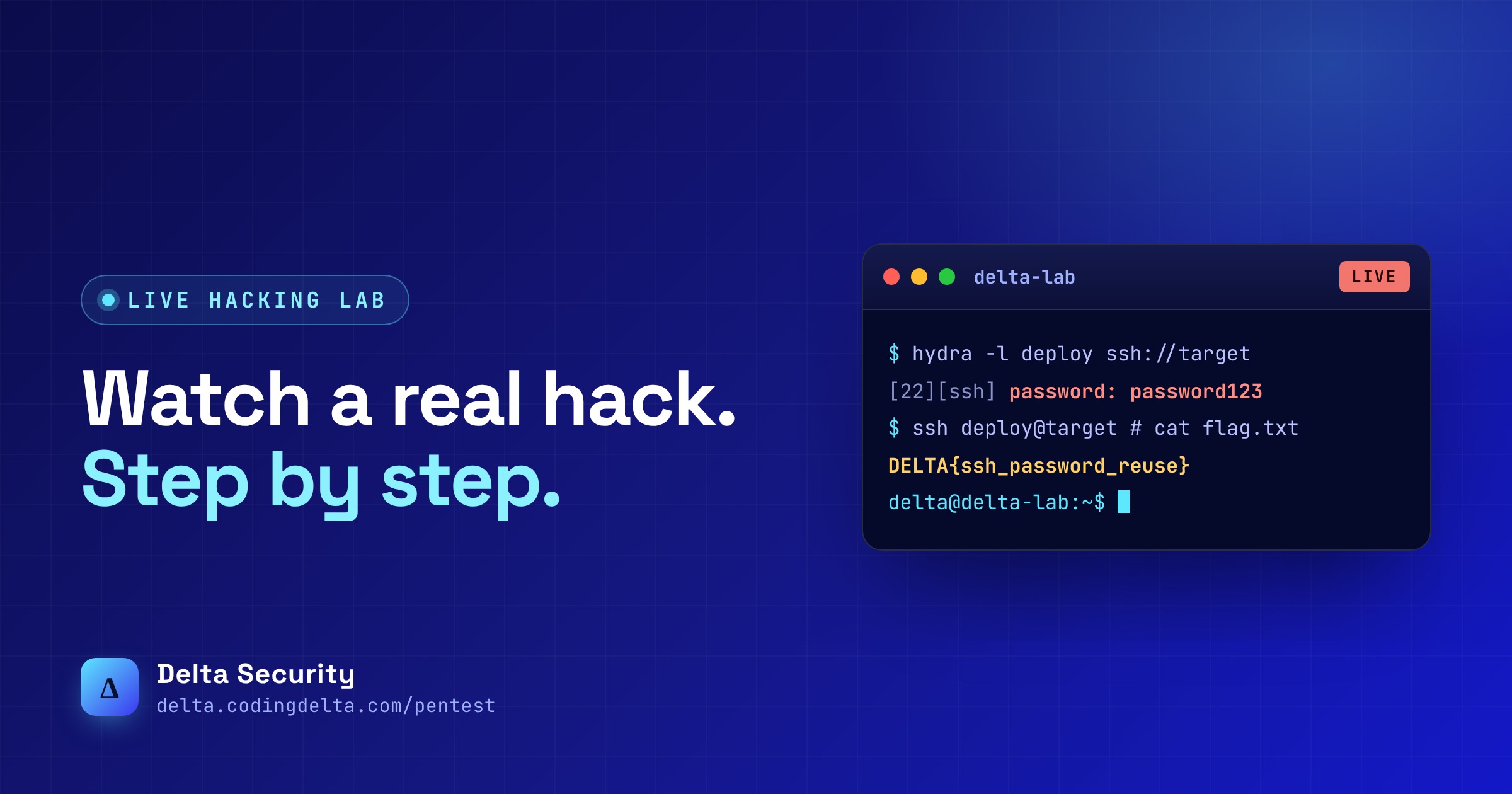
Most security pages tell you they're good at their job. We'd rather show you. So we built a small, interactive penetration lab: open it in your browser and watch real attack tools break into our own throwaway servers, one step at a time, with a plain-language explanation of what just happened and how we stop it.
It is the opposite of a jargon-filled report. You see the scan, the crack and the captured "flag" the way an attacker would, and next to every step you see the fix. Knowing the attack from the inside is what proves you can prevent it.
Try it yourself at delta.codingdelta.com/pentest →
How the lab works (and why it's safe)
Everything runs against servers we create ourselves and throw away straight afterwards:
- Only our own systems. The targets are disposable containers in an isolated environment with no connection to the internet. No third-party system is ever touched.
- No free-form shell. You pick from fixed, scripted attacks. You can't type arbitrary commands; the lab only runs the exact steps we scripted against our own target.
- Real tools, real exploits. The scans and attacks use the same tools a real attacker uses —
nmap,hydra,sqlmap,curl— not a pre-recorded video pretending to be a terminal.
You start a session with your e-mail (and a one-time code), then drive the attack yourself: run each step, read the output as it streams in, and see the vulnerability and its fix side by side.
The examples in the lab
Each scenario is a different class of attack. Here's what you'll see, and the one-line version of how it's prevented.
1. A weak SSH password
The classic way in. We scan the server, find the SSH door open, and guess the password (password123) from a list of common ones in seconds. One command later we're logged in and reading files.
The fix: turn off password logins in favour of SSH keys, restrict SSH to known addresses or a VPN, and block repeated guesses automatically (fail2ban).
2. SQL injection in a login form
A login form that drops whatever you type straight into a database query. A single quote breaks the query — the classic sign — and a crafted input logs us in without a password. From there we read out the entire user table and its secrets. The fix: use parameterised queries (prepared statements), never trust visitor input, and put a web application firewall in front.
3. A PHP web shell via a shipped dev tool (CVE-2017-9841)
A PHP site that accidentally published a development file — PHPUnit's eval-stdin.php, which runs whatever you send it — into its public web root. Through that one file we run our own code on the server, no login required.
The fix: never install dev dependencies in production (composer install --no-dev), keep vendor/ out of the web root, and don't run the web server as root. This remains one of the most-exploited PHP flaws in the wild.
4. Apache path traversal → remote code execution (CVE-2021-41773)
A version of the Apache web server (2.4.49) with a flaw in how it handles paths. With a cleverly encoded ../ we read files far outside the website — like the server's user list — and then turn the same trick into running commands.
The fix: upgrade Apache (2.4.51+), deny access to the filesystem by default, and disable CGI if you don't need it.
5. Shellshock — commands hidden in a header (CVE-2014-6271)
An old script run by a pre-patch version of Bash. Because web servers hand HTTP headers to scripts as environment variables, we smuggle a command into something as innocent as the browser-name header, and it runs on the server. The fix: patch Bash (this bug is from 2014 and still gets scanned for daily), and don't run CGI scripts through Bash.
6. Heartbleed — reading the server's memory (CVE-2014-0160)
A different class of attack: no shell, just a leak. An old OpenSSL version answers a malformed "heartbeat" by handing back up to 64 KB of its own working memory — which can contain session data, passwords or encryption keys. We read a secret straight out of a running server, and it leaves no trace. The fix: upgrade OpenSSL, and — because anything that leaked may already be copied — replace the server's keys and certificates and reset passwords and sessions.
7. Struts 2 — code execution via a header (CVE-2017-5638)
The flaw behind the Equifax breach. A Java web framework evaluates a crafted Content-Type header as code, so a single request runs commands on the server without any login.
The fix: patch Struts, keep sample/showcase apps off production, put a web application firewall in front, and run the app with least privilege.
What it proves
Every one of these is a real, well-known vulnerability — most of them actively exploited, several still being scanned for right now. The point of showing them isn't shock value. It's that the people who can take a system apart, step by step, are the people who know exactly where to reinforce it. You can't defend against an attack you've never watched happen.
That's also why the lab pairs every step with its mitigation: the demo is the "why", and the fix is the "what to do".
See it for yourself
The lab is free and runs in your browser — no software to install, nothing touched but our own servers.
Open the penetration lab at delta.codingdelta.com/pentest
Want this on your own environment? What you see in the lab, we also do on-site: a full, thorough security test of your systems, with a clear report and concrete fixes. Talk to us and we'll set it up.
Curious what this could do for you?
We're happy to think along — over coffee on the Keizersgracht or on a video call.