The Netherlands has hundreds of thousands of poorly insulated homes, and many of the people living in them struggle with their energy bills. Renovating them one by one is slow and expensive: every home gets its own inspection, its own advice and its own quote.
KnopOm takes a different route. It fights energy poverty by renovating homes in bulk: find large groups of comparable homes, design one standard, repeatable renovation package for them, and roll it out at scale. Same type of home, same recipe, much lower cost per home.
That approach stands or falls with one question: which homes are actually comparable? We built the data platform that answers it.
Key takeaways
- One view of every home. The platform enriches a housing provider's address list with public data: building records, energy labels, 3D building geometry and energy consumption.
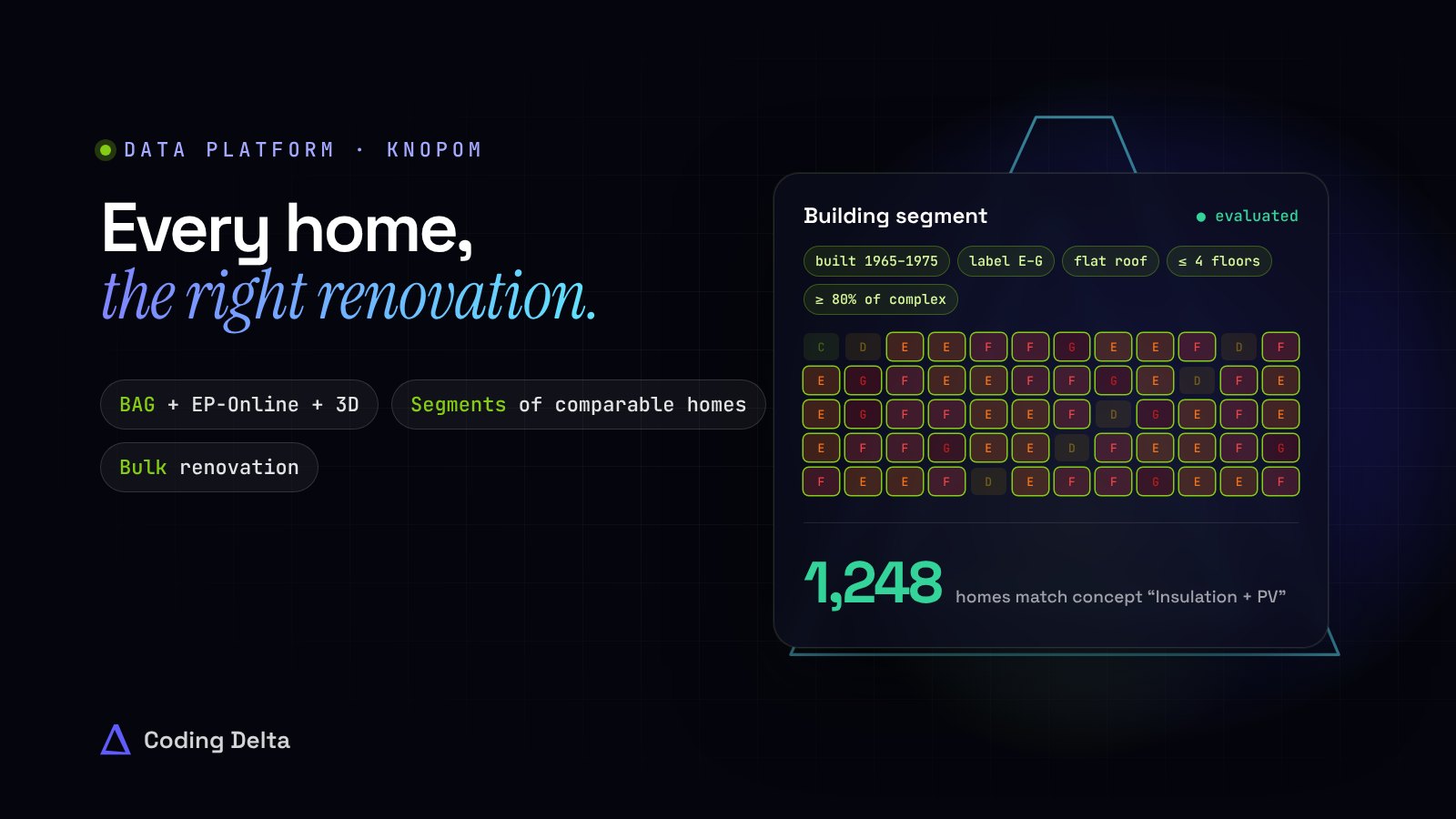
- Comparable homes, grouped automatically. Building segments are defined as rules (construction year, energy label, roof type, height, and more) and evaluated across the whole portfolio.
- Renovation concepts, matched at scale. For each standard renovation package, the platform shows exactly which complexes and addresses qualify.
- Built for real portfolios. Large imports, evaluations and exports run as background jobs, so tens of thousands of addresses are processed without anyone waiting on a spinner.
- One platform, many organisations. Housing associations and other partners each get their own secure workspace, roles and data.
The problem: the data exists, but it's scattered
To decide whether a home fits a standard renovation, you need to know a lot about it. When was it built? What's its energy label? Is the roof flat or pitched? How many floors does the building have, and how high is it? How much energy do the residents use?
Almost all of that information exists. It's just spread over many sources: the national building register, the energy-label database, 3D building models, grid operator data and the housing provider's own spreadsheets, each with its own identifiers and formats. Combining it for one home is a puzzle. Doing it for an entire housing portfolio, by hand, is impossible.
How the platform works
1. Import the portfolio
A housing association uploads its addresses, often straight from an Excel file. The platform recognises the addresses, links them to the official building records and groups them into complexes, the way housing providers already think about their stock.
2. Enrich every address automatically
For every address, the platform then pulls in public data:
- BAG, the Dutch register of addresses and buildings: construction year, use and surface area.
- EP-Online: the official energy label.
- 3D BAG: the 3D geometry of the building, from which we derive the roof type, the estimated building height and the number of floors.
- Small-consumer data from grid operators: average energy consumption in the area.
On top of that, organisations can import their own documents, such as inspection data, maintenance plans or earlier measurements, in any column layout. The platform maps those columns and links each record to the right address, so a provider's own knowledge sits next to the public data.
3. Define building segments
Next comes the heart of the bulk approach: building segments. A segment is a group of comparable homes, defined as a set of rules. For example: built between 1965 and 1975, energy label E or worse, a flat roof, and at most four floors.
Rules can work on the level of a whole complex too: a complex only counts if, say, at least 80% of its addresses meet a criterion. That matches reality, because you renovate a block of homes together, not a single apartment in the middle of it.
4. Match renovation concepts
A renovation concept is a standard package of measures, such as a specific combination of insulation and solar panels. Each concept has its own requirements, defined with the same flexible rule builder. The platform evaluates every concept against the full portfolio and shows exactly which complexes and addresses qualify, with per-rule results so you can see why a home does or doesn't fit.
5. Act on the results
Results can be explored in the dashboard, with charts of energy labels, construction years, roof types and consumption, or exported for planning, quotes and subsidy applications. Change a rule, rerun the evaluation, and the whole portfolio is reassessed.
Built for scale
A housing portfolio isn't a handful of addresses, and enriching each one means many calls to external sources. So everything heavy runs in the background:
- Job queues handle imports, data enrichment, evaluations and exports in batches, with live progress and automatic retries.
- Fast queries on a PostgreSQL database with pre-computed views keep the dashboard responsive, even with large portfolios.
- Dynamic rules are translated into efficient database queries, so a new segment or concept can be evaluated across the whole portfolio in one go.
- Secure multi-tenancy: every organisation works in its own workspace, with roles that decide who can view, import or change data.
Why this matters
Bulk renovation only works if you can find the bulk. With all the data about a home in one place, and comparable homes grouped by clear rules, KnopOm and its partners can go from "we have 10,000 homes" to "these 1,200 homes fit this concept" in minutes instead of months. That's faster planning, sharper quotes, better-founded subsidy applications, and ultimately more homes renovated for the people who need it most.
For us, it's the kind of project we love: real impact, messy data from many sources, and a platform that turns it into decisions.
Building something similar?
Do you need to combine public data, your own files and smart rules to make decisions at scale? That's exactly what we build. See how we approach AI and automation, or get in touch.
Curious what this could do for you?
We're happy to think along — over coffee on the Keizersgracht or on a video call.